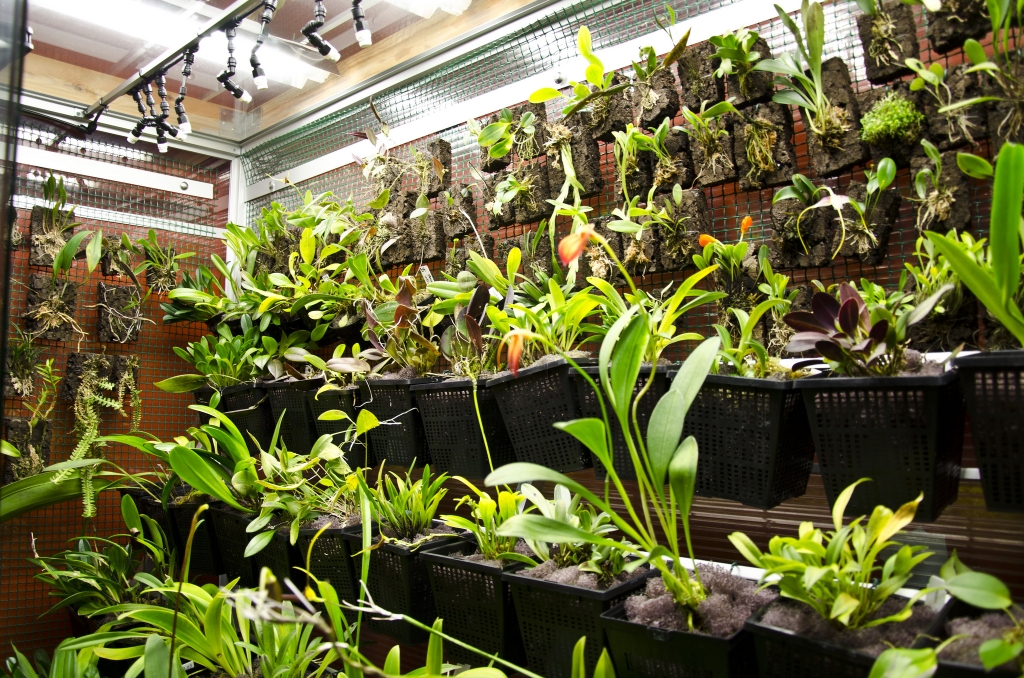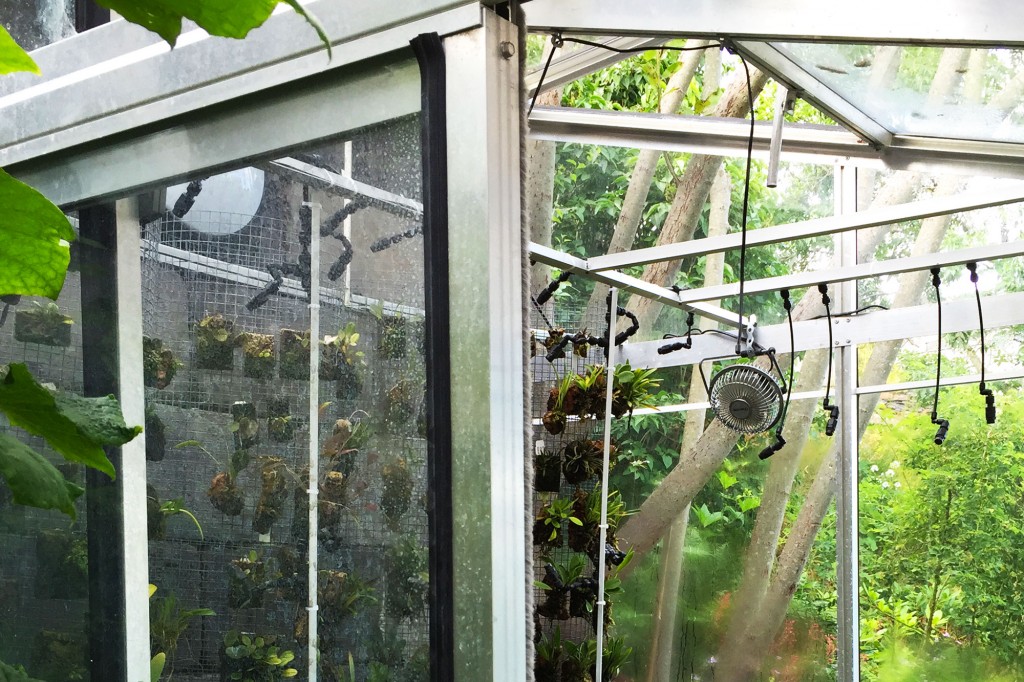
This is a wonderfully vigorous plant with nice fleshy dark green leaves and intense chocolate colored flowers. It blooms every winter for me, and this year it started sometime before the new year and just now finished after almost five months of blooming on six inflorescences. The inflorescence grow out from the midrib at mid leaf and hold a long string of nodding flowers measuring about a centimeter tall. It is a small to medium sized, warm to cool growing growing epiphyte from Mexico to Northern Venezuela where it grows at altitudes ranging from 800 to 1800 meters. I grow mine potted, although not much media will fit in the pot anymore which instead is completely full of roots. It has an amazing root system! It enjoys humid but not wet conditions under medium/ low light in the cool vivarium. Accepted Name: Stelis immersa (Linden & Rchb.f.) Pridgeon & M.W.Chase, Lindleyana 16: 263 (2001). Synonym: Pleurothallis immersa Linden & Rchb.f., Bonplandia (Hannover) 3: 224 (1855).
Specklinia alata
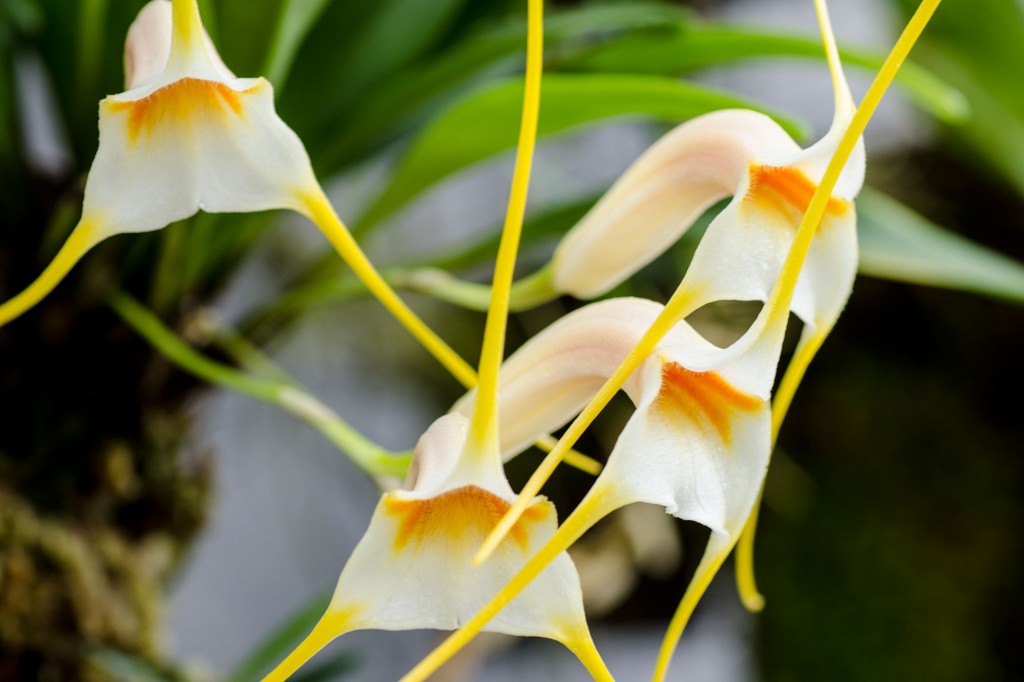
In my mind this is always going to be a Muscarella, but Kew want to call it Specklinia, so I guess I will fall in line. At least for the title of this post. It is a miniature epiphyte from Mexico to Central America, found at altutudes ranging from 180 to 1 380 meters. So is actually a warm to intermediate grower that I am growing cool, but it seems to be doing alright with that too. It is a very small plant, the leaves measure only about 3 cm long. It produces a rather thin and long (50 mm), successively single flowered, inflorescence with a small (5-7 mm) flower dangling at the end like a tiny butterfly. Hince its rather apt common name ”the winged Pleurothallis“. It started blooming sometime this winter, I think I missed it for a long time because it is so small, and it is still going. I grow it mounted on cork in the cool vivarium, humid wet and breezy under medium light. Accepted Name: Specklinia alata (A.Rich. & Galeotti) Solano & Soto Arenas, Icon. Orchid. 5-6: x (2002 publ. 2003). Synonyms: Specklinia hastata (Ames) Pridgeon & M.W.Chase, Lindleyana 16: 258 (2001). Muscarella marginata (Rich.) Luer, Monogr. Syst. Bot. Missouri Bot. Gard. 105: 111 (2006).
Scaphosepalum anchoriferum
This wonderfully strange looking orchid hail from the mountains of Central America where they can be found at elevations from 1100 to 2000 meters. It is an intermediate epiphyte that usually blooms in the spring to summer in nature, but mine started around the new year and has been blooming all winter. The flowers measure about 1 cm wide and grow on a fairly long, single descending to horizontal successively flowered inflorescence. I love the provocative, phallic shape. It asks for no excuses, just being oh so orchid! I grow it mounted on cork in the cool vivarium, very humid with good air circulation, medium wet and fairly bright, about 20 cm from the light.
Masdevallia striatella
This is a small intermediate growing epiphyte from Central America. It can be found in mountain cloud forest from Costa Rica to Northwestern Venezuela at altitudes ranging from 400 meters up to 2500 meters. Flowers are small, only about one centimeter long, but the nice coloration makes up for any shortcomings in size. It usually blooms in the late fall/ early winter in nature, and it has been doing the same for me this year, blooming from October through most of the winter. I grow it mounted on bark in the cool vivarium, very humid but not too wet with good air circulation and under medium light. Masdevallia striatella Rchb.f., Gard. Chron., n.s., 26: 103 (1886).
Dracula sodiroi subsp. erythrocodon
So, the Dracula indulgence continues. Dracula sodiroi is an intermediate to cool growing terrestrial or epiphytic species named after Father Sadira who first discovered it in 1900. It grows in the northwestern regions of the Pichincha provice in Ecuador at altitudes between 1800 to 2300 meters. The bell shaped flowers form on erect racemes and the pendant growing style further enhances the bell connection. Apparently the characteristic to produce more than one flower at the same time on this erect raceme is rather unique within the genus. According to the book Draculas of Ecuador, the flowers of subsp. erytrocodon are bright red color in contrast to the orange color of the typical form. I rather prefer this lovely shade of red and I am glad mine turned out to be that of the latter. But of course Kew does not recognize the subspecies definition. It is quite sensitive to drops in humidity, last year the flowers would not open all the way, and this year the tips of the sepals have shriveled ever so slightly, but I am still very pleased as it is at least an improvement from last year. Besides, I am just happy that is is blooming. I lost more than 50% of the plant mass last year during the devastating fungus outbreak. I grow it potted in the cool vivarium under low light, rather wet and in high humidity with good air circulation. Dracula sodiroi (Schltr.) Luer, Selbyana 2: 197 (1978). Synonym: Dracula sodiroi subsp. erythrocodon Luer & Dalström, Monogr. Syst. Bot. Missouri Bot. Gard. 64: 125 (1997).